Notarized Translation Qatar
Accurate Translation + MOJ-Licensed Notarization — One Provider, One Visit, MOFA-Ready.
Arabic · English · Urdu · Hindi · Tagalog · Nepali · Bengali · Sinhala
Translation Notary Desk
MOJ-Licensed & MOFA Ready
- MOJ Notary Stamp & Signature
- MOFA Attestation Support
- Certified True Copy (CTC)
What Is Notarized Translation — and Why Is It Different from Regular Certified Translation?
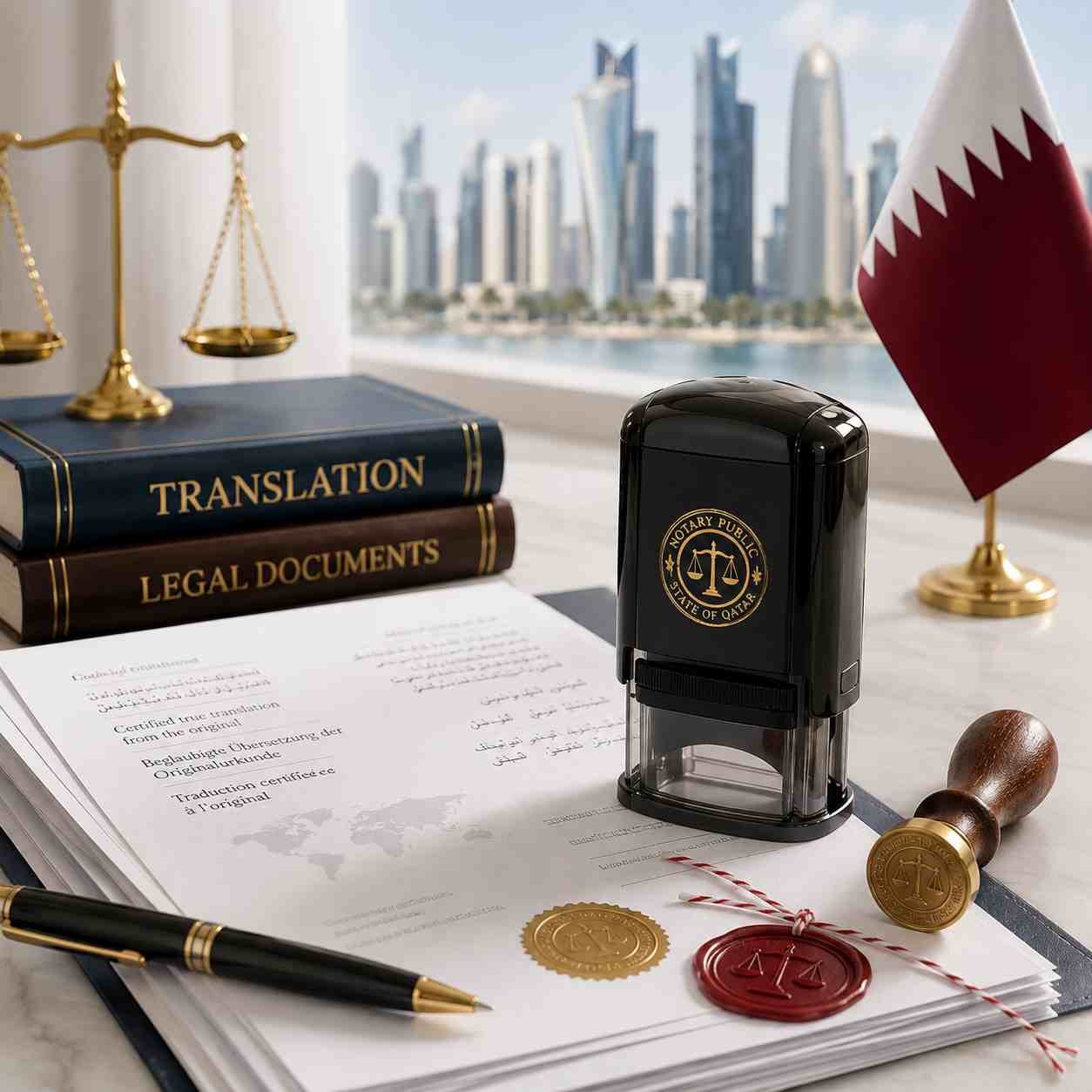
A notarized translation is a two-part process: first, your document is translated by a qualified translator; second, the translator's declaration of accuracy is formally witnessed and stamped by a MOJ-licensed lawyer. The lawyer's stamp and registration number are added to the translated document, giving it official legal standing with government bodies, courts, embassies, and MOFA.
This is the key difference from a standard certified translation. A certified translation carries the translator's own stamp and declaration — which many institutions accept. A notarized translation goes one step further: a Ministry of Justice-licensed notary independently confirms the translator's identity and witnesses their declaration of accuracy. The notarization adds a second layer of official authentication that some institutions — particularly embassies, courts, and MOFA — specifically require.
In Qatar, this matters because Arabic is the official language of all government processes. Documents issued abroad in English, Urdu, Hindi, Tagalog, Nepali, Bengali, Sinhala, or any other language must be translated into Arabic before they can be processed by Qatari authorities. When those authorities additionally require notarization, the translation must carry the MOJ lawyer's stamp — not just the translator's.
At Notary Qatar, we coordinate the full process: translation by a qualified, subject-specialist translator, followed immediately by notarization through our MOJ-licensed lawyer. You receive a single, complete document that is ready for submission — or for the next step, MOFA attestation, if required for overseas use.
Step 1: Translation
Qualified subject-specialist translator renders the document accurately — preserving meaning, legal terminology, format, and all stamps and seals from the original.
Step 2: Notarization
Our MOJ-licensed lawyer witnesses the translator's declaration of accuracy, verifies the translator's credentials, and applies their official MOJ stamp and registration number to the document.
Step 3: MOFA-Ready
The notarized translation is accepted by Qatari authorities, courts, banks, and employers. For documents going abroad, it proceeds to MOFA attestation and embassy authentication.
Which Type of Translation Does Your Institution Actually Require?
Qatar authorities, embassies, courts, and employers use several translation terms that are often confused. This table explains each clearly so you know exactly what to request before visiting.
| Feature | Notarized Translation | Certified Translation | Sworn Translation | Attested Translation |
|---|---|---|---|---|
| What It Means | Translation + MOJ-licensed notary stamp on translator's declaration | Translation with translator's own accuracy declaration and stamp | Translation sworn under oath before a legal authority — translator takes an oath of accuracy | Notarized translation that has additionally been verified by MOFA or an embassy |
| Who Certifies It | MOJ-licensed notary + qualified translator | Qualified translator only | Sworn translator before a judicial or notarial authority | MOFA or embassy stamps on an already-notarized translation |
| MOJ Stamp? | Yes | No — translator stamp only | Sometimes — depends on authority | Yes + MOFA/Embassy stamp |
| Accepted By | MOFA, courts, embassies, Qatar ministries, banks, employers | Most employers, universities, banks, some government departments | Courts, specific government authorities requiring sworn statement | All overseas authorities — countries requiring MOFA/embassy chain |
| Qatar Context | Most common requirement for official submissions | Accepted by many employers and universities | Less common — confirm with authority | Required for most overseas document submissions |
| Available at Notary? | Yes — this page | Yes — via certified translation partner | Yes — confirm purpose first | Yes — we guide on the MOFA chain |
The Complete Qatar Document Authentication Chain — From Translation to Overseas Acceptance
Many clients receive a notarized translation only to discover the receiving institution — particularly overseas — requires additional steps. Understanding the full chain upfront prevents incomplete submissions and avoids wasted trips.
Qualified Translator
Your original document is translated by a qualified subject-specialist translator into Arabic (or the target language). The translation is accurate word-for-word, preserves all stamps, seals, and formatting from the original, and uses the correct legal or academic terminology.
MOJ-Licensed Lawyer
Our MOJ-licensed lawyer witnesses the translator's signed declaration of accuracy, verifies the translator's credentials, and adds their name, MOJ registration number, and official stamp to the translation. This elevates the document to notarized status.
MOFA Attestation + Embassy Authentication
The notarized translation is submitted to Qatar's Ministry of Foreign Affairs (MOFA) for attestation — confirming the MOJ lawyer's stamp is genuine. For documents going to a specific country, the destination country's embassy in Doha then authenticates the MOFA stamp. This completes the international document chain.
We advise which layers your specific submission requires at the time of collection — so you never discover a missing step after leaving our office.
Every Document Category We Handle for Notarized Translation in Qatar
We provide accurate translation combined with MOJ-licensed notarization across all primary legal, official, and administrative document categories.
Academic & Educational Documents
For university applications, credential evaluations, employer submissions, and professional licensing.
- Degree certificates and diplomas — undergraduate, postgraduate, doctoral
- University transcripts and grade reports
- School leaving certificates and secondary qualifications
- Professional licensing certificates — nursing, engineering, teaching
- Training completion certificates and vocational qualifications
Personal & Civil Documents
For residency, employment, banking, and government registration in Qatar.
- Birth certificates — for residency, sponsorship, and child registration
- Marriage certificates — for spousal visa and family sponsorship
- Divorce certificates and court divorce decrees
- Death certificates — for estate and inheritance matters
- National ID and passport — for name variation or identity submissions
Legal & Court Documents
For court submissions, legal proceedings, notarized instruments, and international legal use.
- Power of attorney documents — for property, financial, and legal authority
- Court judgments and legal decisions for cross-border recognition
- Affidavits and statutory declarations requiring Arabic translation
- Contracts and agreements for bilateral or multi-jurisdictional use
- Police clearance certificates and criminal record disclosures
Medical & Healthcare Documents
For medical licensing, health authority registration, insurance, and clinical submissions.
- Medical degrees and specialist qualifications for MOPH licensing
- Clinical training certificates and internship records
- Medical reports and diagnoses for insurance or legal purposes
- Hospital discharge summaries for insurance claims or treatment abroad
- Nursing and allied health qualifications for Qatar health authority registration
Corporate & Business Documents
For company registration, banking KYC, tender submissions, and regulatory filings.
- Company incorporation documents and articles of association
- Audited financial statements and balance sheets
- Board resolutions and shareholder agreements
- Commercial contracts and partnership agreements
- Trade licenses and business registration certificates
Embassy & Immigration Documents
For visa applications, immigration processes, and overseas authority submissions from Qatar.
- Visa application supporting documents requiring Arabic or English translation
- Employment and salary certificates for embassy submissions
- Bank statements for visa or immigration financial proof
- Reference and recommendation letters for overseas immigration
- Background and good conduct certificates for immigration compliance
Notarized Translation Languages — Arabic, English, and Expat Community Languages
Qatar's official language is Arabic. All government submissions, court documents, and MOFA-bound documents must be in Arabic. But translations are needed in both directions — and the expat community often needs documents translated from their home country language as well.
| Language Pair | Most Common Documents | Primary Use in Qatar | Community |
|---|---|---|---|
|
Contracts, degrees, certificates, POA, legal documents | Primary government, court, MOFA, and embassy language pair for Qatar | All expats — universal |
|
Birth & marriage certificates, degrees, police clearances | Indian and Pakistani expat document submissions | Indian & Pakistani expats |
|
PSA documents, employment contracts, OFW certifications | Filipino expat sponsorship, POLO, and embassy submissions | Filipino expats |
|
Citizenship certificates, educational records, FEB documents | FEB registration, Nepali embassy, property matters | Nepali expats |
|
NID, birth certificates, BMET documents, academic records | BMET registration, Bangladeshi embassy, banking | Bangladeshi expats |
|
Birth certificates, marriage certificates, SLBFE documents | SLBFE registration, Sri Lankan embassy, EPF/ETF claims | Sri Lankan expats |
|
|
French, German, Spanish, Turkish, Mandarin, and more | Corporate and specialist document requirements | Business & specialist |
Why Notarized Translations Get Rejected — and How We Prevent Each One
Most rejections of notarized translations are avoidable. They happen for predictable, preventable reasons — and our review process catches every one before you leave.
Wrong Translation Type
How We Prevent It: The institution required notarized translation but received certified translation only — or vice versa. We confirm the exact requirement with you before starting, including whether MOFA attestation is also needed on top of notarization.
Translator Not Recognized
How We Prevent It: The translation was done by an unqualified or unrecognized translator whose credentials the institution does not accept. Our translations are prepared by qualified subject-specialist translators whose credentials the MOJ lawyer verifies as part of the notarization process.
Original Stamps Not Reflected
How We Prevent It: Translations that omit or fail to note the stamps, seals, signatures, or official marks on the original document are regularly rejected. Our translators note all stamps, seals, and official marks in the translation with the standard "[Official Stamp]" or "[Signed]" notation.
MOFA Attestation Not Obtained
How We Prevent It: A notarized translation is accepted within Qatar — but for overseas use, MOFA attestation and embassy authentication are usually required as additional layers. We explain this at collection so you know exactly what the next steps are before submitting.
Source Document Is Unclear
How We Prevent It: A translation is only as accurate as the source document. Blurred scans, torn documents, or handwritten originals with illegible sections create translation gaps that institutions flag. We advise you if a document needs to be re-obtained as a clear, legible copy before translation begins.
Notarized Translation Qatar — What Each Expat Community Needs Most
Each expat community in Qatar has specific institutions — in Doha and at home — that require notarized translations of their documents. Here are the most frequent use cases we handle.
Indian Expats
- Degree and transcript translated to Arabic for Qatar employer recognition and licensing
- Birth and marriage certificate translated for family visa sponsorship and child registration in Qatar
- Police clearance certificate (PCC) translated for Qatar residency or overseas immigration
- Power of attorney translated for property or financial matters in India, with notarization for Indian registration office acceptance
Filipino Expats
- PSA birth and marriage certificate translated to Arabic for Qatar sponsorship and family visa
- Employment contract translated to Filipino/English with notarization for POLO OFW documentation
- Academic credentials translated for professional licensing with Qatar Ministry of Public Health or education authority
- Philippine NBI clearance translated to Arabic for Qatar residence or overseas immigration
Nepali Expats
- Citizenship certificate translated to Arabic for Qatar residency and FEB overseas worker registration
- Educational certificates translated for professional licensing or Qatar employer credential verification
- Marriage certificate translated for spouse visa or family sponsorship application
- Property or land registration documents translated for inheritance or transfer matters in Nepal
Bangladeshi Expats
- NID and birth certificate translated to Arabic for Qatar residency and BMET overseas registration
- Academic certificates translated for employer verification and professional licensing
- Police clearance certificate (PCC) translated for Qatar or overseas immigration applications
- Employment contract translated to Bengali with notarization for Bangladesh Labour Office requirements
Sri Lankan Expats
- Birth and marriage certificate translated to Arabic for Qatar family sponsorship and child registration
- Professional qualification translated for MOPH or employer licensing with notarization
- Employment contract translated to Sinhala with notarization for SLBFE overseas worker documentation
- Police clearance translated to Arabic for Qatar residency renewal or overseas immigration
Pakistani Expats
- CNIC, Nadra-issued birth and marriage certificates translated to Arabic for Qatar sponsorship
- Degree and transcript translated for Pakistan Engineering Council (PEC) or medical license validation
- Court decree translated to Arabic for divorce or custody matter recognition in Qatar
- Property documents translated for overseas registration or inheritance with notarization for Pakistani courts
What to Prepare Before Visiting Our Doha Office for Notarized Translation
Always Required
- Valid passport — original
- Qatar Residence Permit / Qatar ID — original
- Original document to be translated — clear, legible, official copy
- Intended submission institution — name and country
- Language required (source → target): e.g. English to Arabic
Bring If Applicable
- Certified true copy if the original cannot leave your possession
- Previous translation if you need it reviewed or re-notarized
- Institution's specific requirements or checklist if you have one
- For MOFA-bound submissions: any attestation chain instructions
- For corporate documents: company letterhead or authorization confirming you may present the document
IMPORTANT: Bring the original document — not a photocopy. Our translators translate from the original. If the original cannot leave your possession, we can work from a certified true copy, but quality and accuracy depend on legibility.
Send Your Scan via WhatsApp FirstHow We Handle Notarized Translation at Notary Qatar
Confirm Type & Purpose
We confirm the correct translation type (notarized, certified, or attested) based on the receiving institution's requirements. We also confirm whether MOFA attestation or embassy authentication is needed in addition to notarization — so the process is scoped correctly from the start.
Translation by Specialist
Your document is translated by a qualified subject-specialist translator — legal, academic, medical, or corporate, matched to the document type. All stamps, seals, signatures, dates, and formatting elements from the original are preserved and noted in the translation.
Translation Review
The completed translation is reviewed for accuracy, terminology, and completeness. Any unclear sections from the original are flagged and addressed. The translated document is checked against the original before proceeding to notarization.
Notarization by MOJ Lawyer
Our MOJ-licensed lawyer witnesses the translator's signed declaration of accuracy, verifies the translator's credentials, and applies their name, MOJ registration number, and official stamp to the completed translation. The document is now formally notarized.
Collection & Next Steps
Your notarized translation is ready. We advise on the MOFA attestation and embassy authentication steps required if the document is going abroad. You leave with both the notarized translation and full clarity on the next steps in the chain — if any.
Why Choose Notary Qatar for Notarized Translation in Doha
Translation + Notarization — One Visit
We coordinate translation and MOJ notarization under one roof. No running between a translation office and a notary separately — everything is handled in one appointment.
MOJ-Licensed Lawyer
The notarization is performed by a Ministry of Justice-licensed lawyer. The MOJ registration number appears on every notarized translation — confirming official legal standing for MOFA, courts, and embassies.
Subject-Specialist Translators
Legal, medical, academic, and corporate documents are translated by specialists in that field — not general translators. Correct terminology in the translated language is not a bonus; it is the minimum standard.
8+ Languages
Arabic, English, Urdu, Hindi, Tagalog, Nepali, Bengali, and Sinhala — with additional languages available on request. We cover the full Qatar expat community language spectrum.
Same-Day Available
Standard notarized translations for common document types are available same-day when the original is clear and complete. Urgent processing for embassy appointments and visa deadlines handled as priority cases.
Rejection Prevention
We confirm the correct translation type before starting and advise on the complete acceptance chain — including MOFA and embassy steps if required. The five most common rejection reasons are addressed before you leave.
MOFA Chain Guidance
For documents going overseas, we explain the MOFA attestation and embassy authentication steps at collection. We do not complete a notarized translation and then leave you wondering what comes next.
Central Doha Office
Concord Business Center, Al Rawabi Street, Al Muntazah, Doha. Accessible from Al Sadd, West Bay, The Pearl, Bin Omran, Lusail, and Wakra.
Notarized Translation Qatar — Frequently Asked Questions
1. What is notarized translation in Qatar? +
2. What is the difference between notarized and certified translation? +
3. Which documents require notarized translation in Qatar? +
4. Do I need to bring the original document? +
5. What languages do you cover for notarized translation in Qatar? +
6. Do I also need MOFA attestation after notarized translation? +
7. How long does notarized translation take? +
8. Is your notarized translation accepted by Qatar embassies? +
9. Can companies request notarized translation services? +
10. What is the MOFA attestation chain for translated documents? +
11. Can I get a notarized translation in Arabic into English? +
12. Do you offer same-day notarized translation in Doha? +
Get Your Translation Notarized in Doha — One Visit, MOFA-Ready Output
Translation + MOJ notarization handled together. Same-day available for most standard documents.
Notary Qatar provides notarized translation services in Doha, Qatar through a Ministry of Justice-licensed lawyer. We handle notarized translation for Arabic, English, Urdu, Hindi, Tagalog, Nepali, Bengali, and Sinhala documents for all expat communities in Qatar. Our office at Concord Business Center, Al Rawabi Street, Al Muntuzah, Doha is accessible from Al Sadd, West Bay, The Pearl, Bin Omran, Lusail, and Wakra.
Notarized translation in Qatar for academic, legal, medical, corporate, and personal documents. MOFA attestation guidance included. Same-day service available.